
Have you ever come across a painting and immediately recognized exactly who painted it?
That’s what’s known as a recognizable painting style. Yet, when you turn to your work, all you feel is frustration because something’s missing.
Even though you’ve been pouring hours of practice, your paintings look inconsistent, or worse, they look like everyone else’s paintings.
Today, we’ll go through what makes a unique painting style and how you can work towards finding your own recognizable style.
Related articles:
What makes a painting style recognizable?
Artists that have a recognizable painting style usually focus on one aspect of their work and master painting it in a particular way.
1. Brush Work
There are so many types of brushstrokes, and each artist has a particular way they make use of them in their work
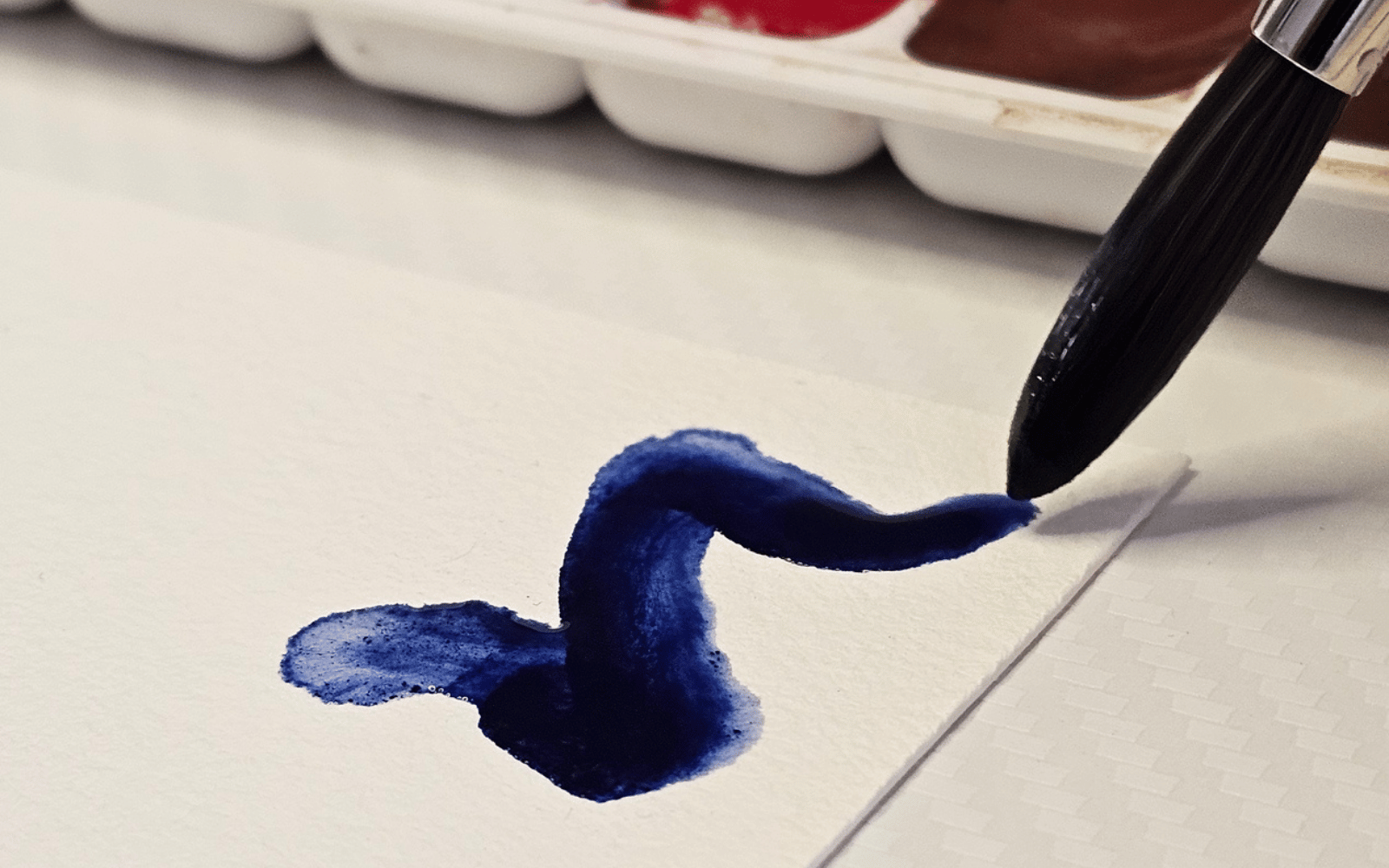
Each brushstroke depends on the pressure, water consistency, load, and pattern.
Some artists work can be recognized for their brushstrokes.
2. Light
Light is an element that plays a crucial role in bringing a painting to life. It can be a building block in the form, texture, and emotional tone of the painting.
Artists use light to guide the eye of the viewer and create striking masterpieces.
How an artist uses light can become a signature of their work.
For example, some use sharp contrasts to build tension in their work. Others may use bright soft light to paint a serene landscape.
3. Color/mood
Color is a major tool that controls the mood of the painting. Some artists use a contrast of warm and cool colors to portray depth. Some prefer bright saturated mixes to capture light, while others prefer muted colors.
It all depends on the artist.
4. Subject
You might see an artist or two who focus on one specific subject. Their focus is what makes them so easily recognisable.
For example, painting house cats. An artist may focus on painting house cats, and they’ve spent years perfecting their technique to paint fur.
Another artist may choose to focus on street cats…etc.
5. Detail, edges & texture
Some artists’ work can be recognized by how detailed or loose their paintings are. This includes how they incorporate texture and edges in their work.
What you’re looking for is a consistent pattern across a body of work.
Examples of Watercolor Artists’ Painting Styles
To deepen your understanding, let’s take a look at three contemporary watercolor artists with exceptional skill and recognizable painting styles.
We’re going to go look at some of their work and analyse their unique painting styles.
Chris Hull
The first artist whose work we’re going to be looking at is Chris Hull, or C.J Hull, a watercolour artist based in the stunning landscapes of North Wales, on the edge of Snowdonia National Park.
Immediately, the first thing that drew my attention to his paintings was the sun rays and how he manages to capture the atmosphere and light in his landscapes.
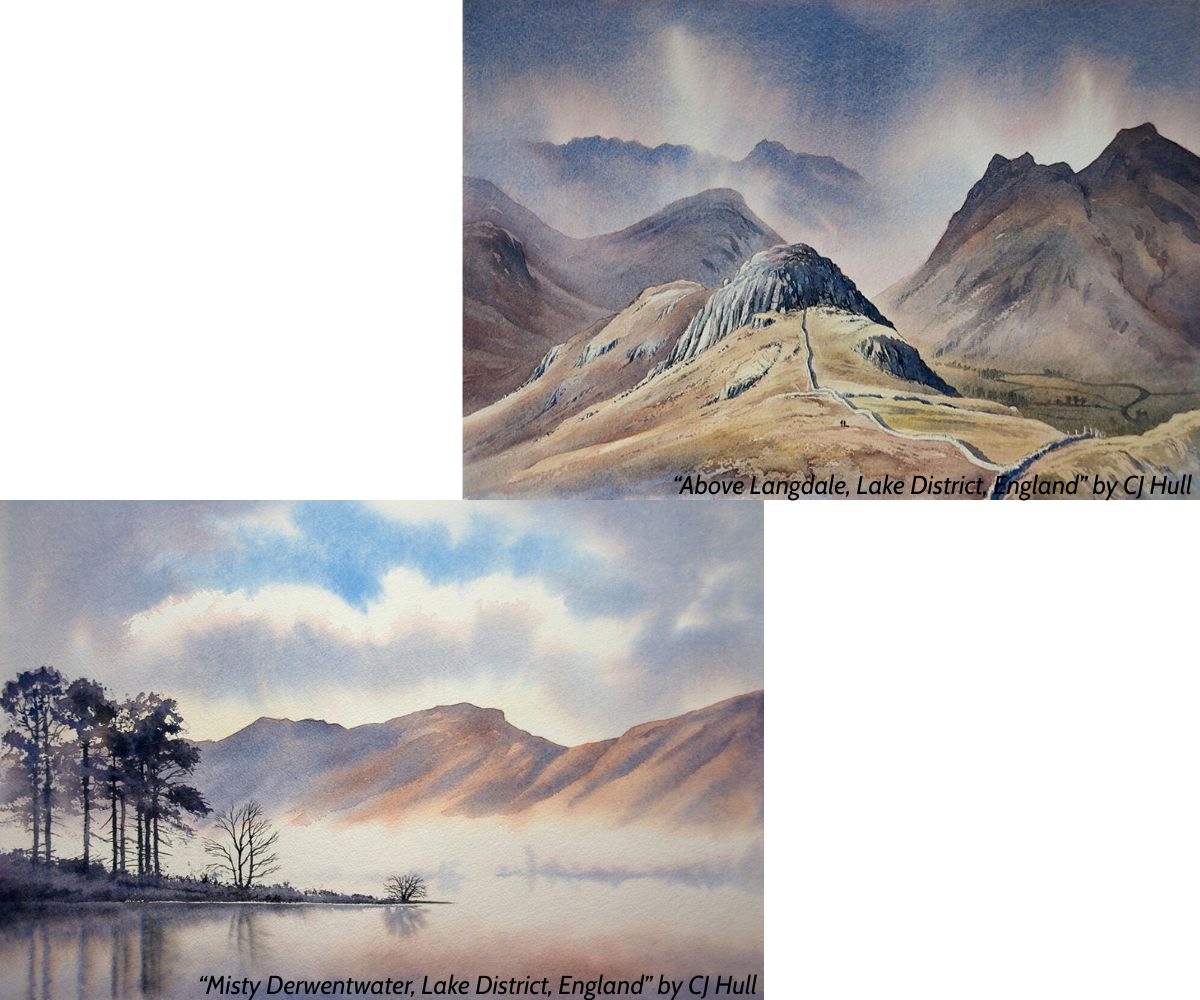
Hull is selective about which details to add in his painting.
He manages to add just the right amount of details and value contrast in the foreground to separate it from the background without drawing the attention away from the focal point (the mountain).
The pathways in both paintings below are carefully placed to draw the viewer’s eye back to the sun rays and mountain.
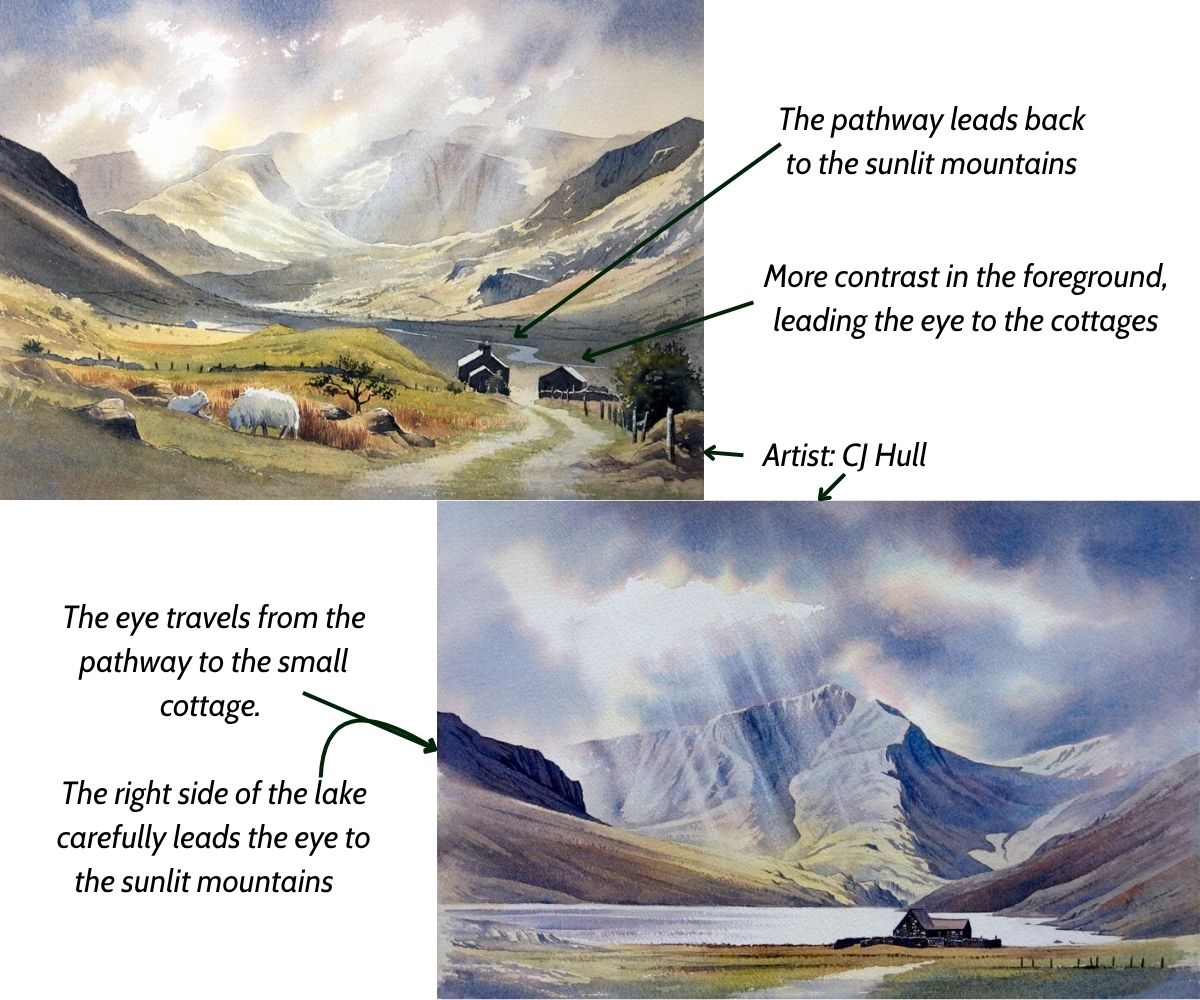
He doesn’t lean toward dark color mixtures often, and if he does, it’s usually intentional. His paintings utilize a range of soft, lost, and hard edges deliberately to capture depth.
Eric Christensen
Unlike Hull, Christensen creates highly detailed watercolor paintings.
He works with sharp value contrasts and studies how light interacts with highly reflective surfaces such as glass, metal spoons, and glossy fruits. Even the table tops seem to have light bouncing off of them.
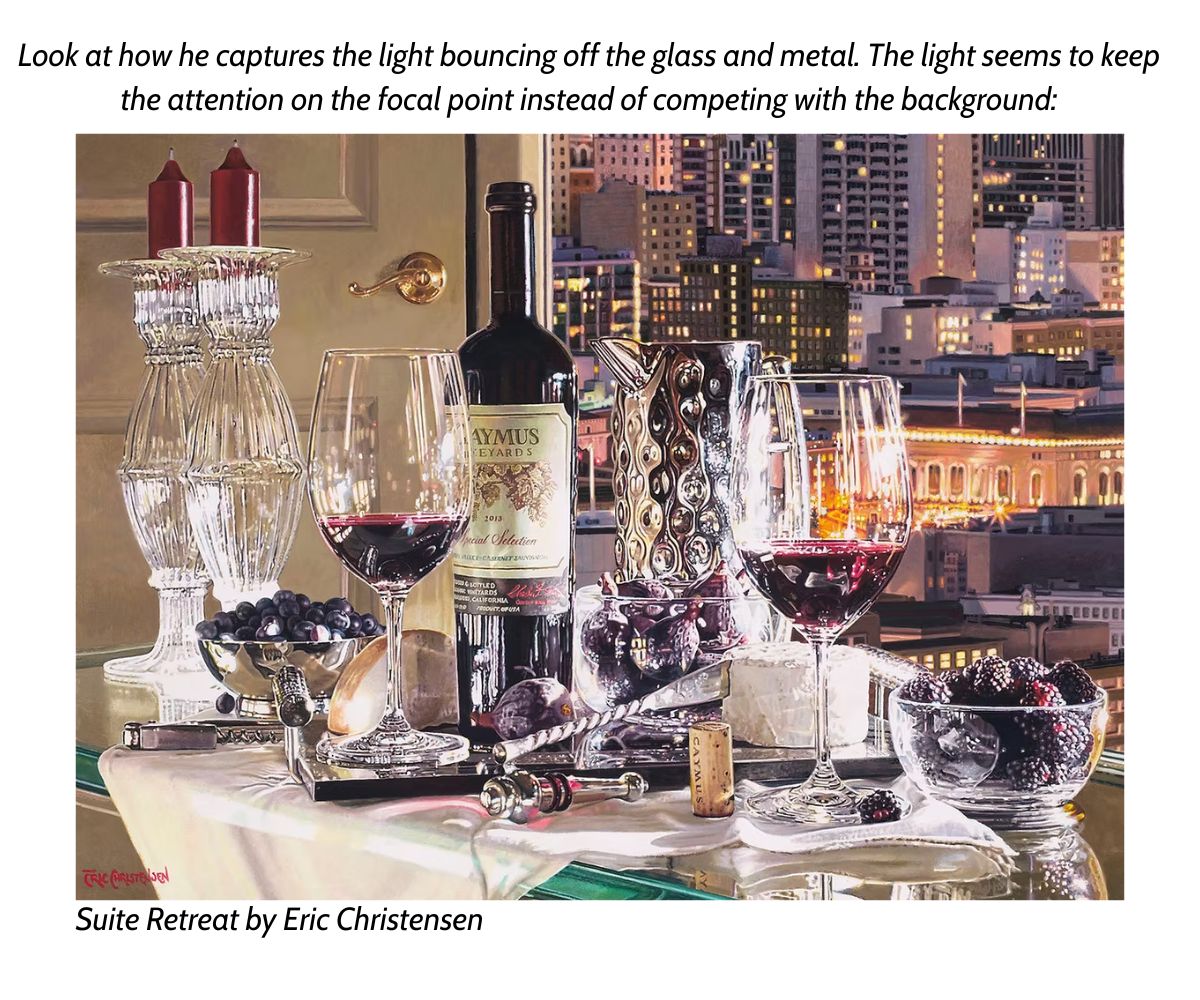
Christensen’s painting style can be differentiated by subject. He works mostly with wine glasses, wine bottles, fruit, cheese, that sort of thing.
What I find most interesting about Christensen’s work is how he manages to add depth even though his backgrounds are heavily detailed.
He does this through:
- Overlapping- Placing objects over the background elements
- Scale- The wine glasses and bottles take up a majority of the space and are much larger because they are closer to the viewer (being the focus of the painting).
- Strong value contrast in the foreground- While the background is still heavily contrasted, the foreground has even sharper contrast.
- Sharper edges in the foreground and a slight softening of edges in the background details.
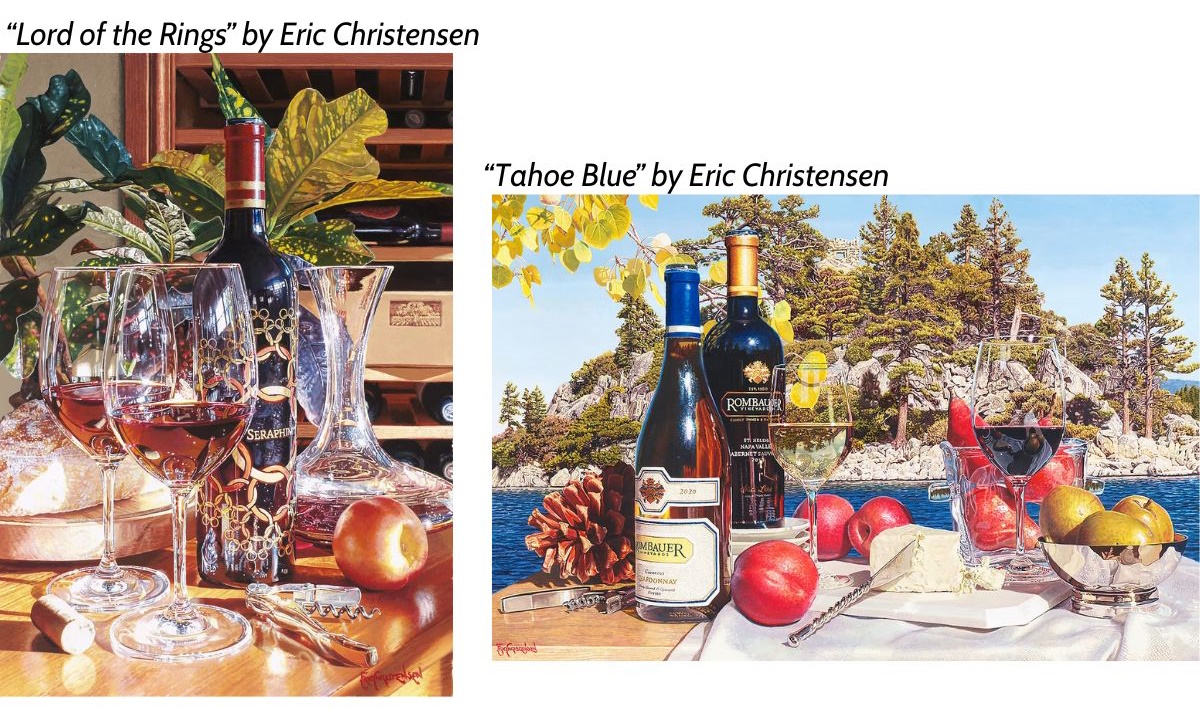
He uses these tools to demonstrate depth very subtly. Meanwhile, Hull demonstrates atmospheric perspective and depth much more clearly through the use of
Adem Potas
Key Observations:
- Uses a variety of subjects
- Very expressive through color
- Not afraid to explore very dark mixes
Potas takes a different approach to his paintings. Many of Potas’s paintings aren’t centered around the same subject, yet they are consistent enough to be recognizable.
Potas’s work is more intentionally expressive. He almost exaggerates the relationship between dark and light using color temperature and value contrasts. This is one of the reasons why his painting style is recognizable.
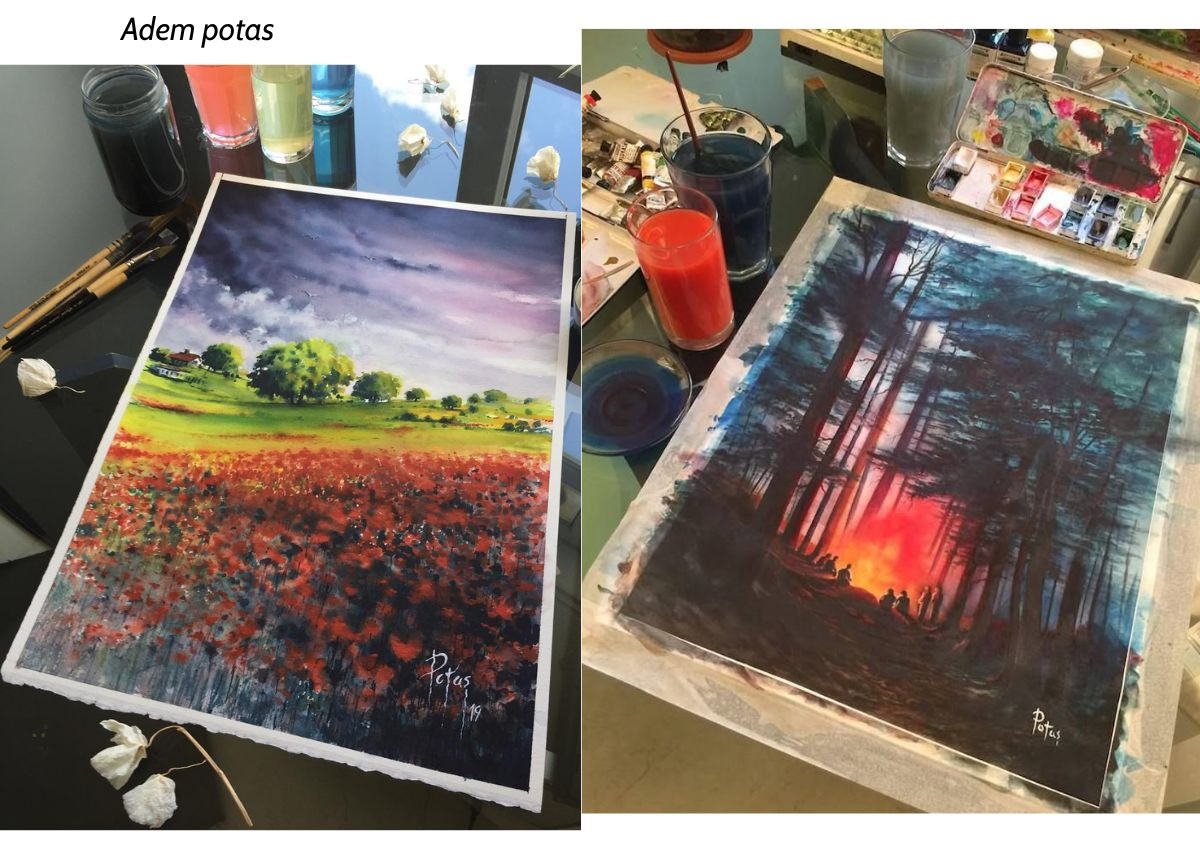
Compared to Christensen, his brushwork is more expressive. You can clearly see the irregular brushstrokes, streaks, and areas where the pigments merge together. Where as Christensen describes each individual object in his paintings.
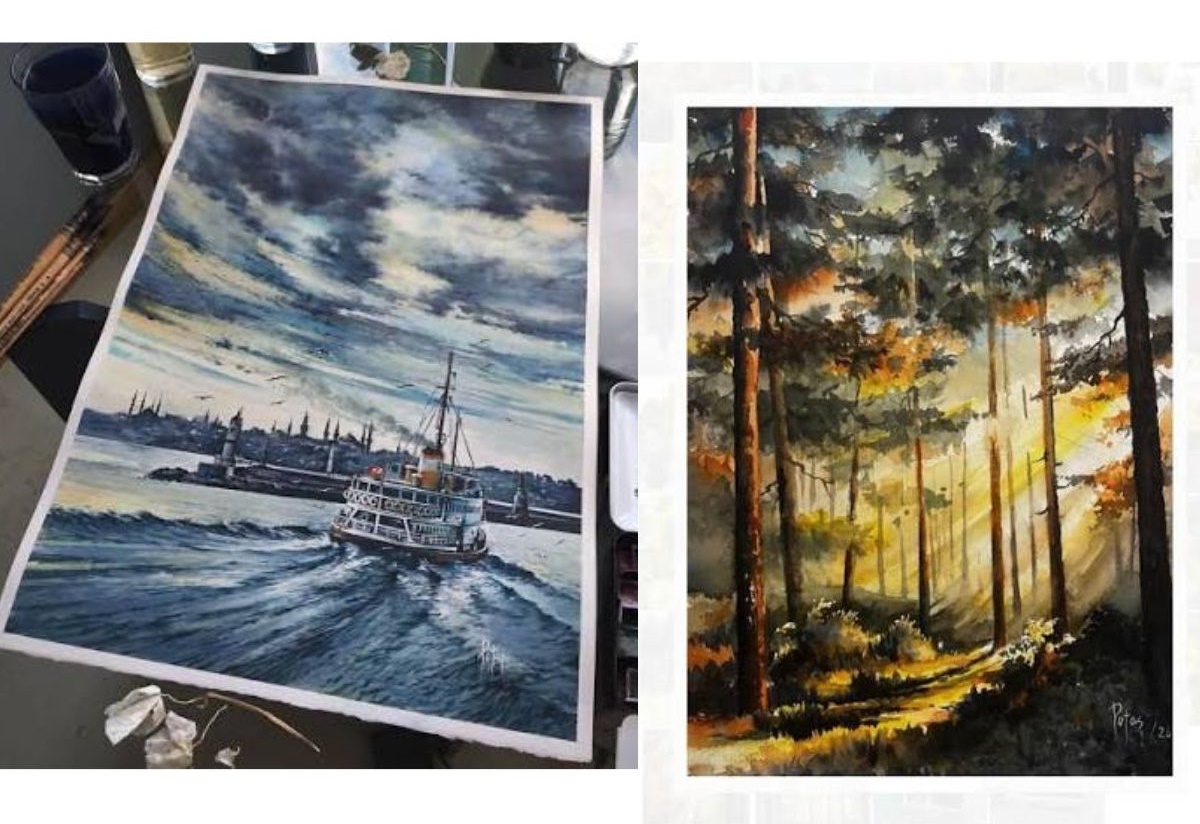
Potas uses dramatic contrasts between color temperature and value contrasts. He leans towards very dark color mixtures, highlighting the contrast between light and dark. This is done intentionally to draw the attention of the viewer.
Potas uses very deep dark colors.This is something many beginners tend to avoid; however can yeild stunning results. This proves that don’t be afraid to explore/experiement with an idea.
The common ground
While each artist has a unique painting style, they all have one thing in common. They all demonstrate that a recognizable watercolor style does not come from one isolated choice.
Instead each one has a selection of repeated decisions regarding subject, value structure, edges, color, lighting, detail, composition, and the handling of the medium that worked well together.
These decisions come from years of developing their artists intuition. None of them are right/wrong, they each have unique prefences.
Stop searching for your painting style
Developing a recognizable painting style is less about searching for it and more about learning what you gravitate towards.
It’s about developing your instincts as a painter through practice and self discovery.
As an artist, how are you connected to your work? To figure this out, pay attention to what captures your interest when it comes to subject matter, color, and technique.
This requires two things: exploring and reflecting.
Let’s take a closer look…
Exploring
As an artist, exploring is encouraged! There are so many ways to explore with your artwork, and it’s not limited to subject matter.
These are a few examples:
- Mediums- Combining mediums, such as colored pencil and watercolor, ink and wash paintings, etc.
- Materials– Some people use coffee, painting with a sponge, using rubbing alcohol, salt, plastic wrap.
- Technique– Watercolor has so many techniques and so many ways to paint wet on wet, wet on dry, lifting…etc.
- Color– Playing around with certain color combinations to create different moods in your painting.
- Light– Some artists spend years studying light and learning how to capture it in their work.
Reflecting
Sometimes it’s good to explore. Other times it’s good to take a step back, pause, and reflect on what’s working and what isn’t.
The last thing you want is to be all over the place; you need discernment, and this is where reflection comes in.
Here are some reflective questions you can ask yourself when studying an artist’s work:
- What drew my attention to this piece? Was it the colors used, the subject, the way the artist portrayed light…etc.
- What would I do differently? Is it the color choice, temperature of the piece?
- Is their work more realistic and detailed or expressive and loose?
- How do they make use of watercolor techniques, and how does it make their painting work? (For example, if they used wet on wet to paint soft animal fur.)
Next are some questions to ask yourself when looking at your pieces:
- Which paintings did I enjoy painting the most and why?
- Which part of my painting turned out really well?
- Which part of the painting do I wish I had done better, and how could I do it better?
- What story was I trying to tell in this painting? (This doesn’t have to be so surreal or deep; it can be simple. For example, conveying how rough tree bark can be through texture).
Remember you’re not starting from scratch; you can have so much insight when you pause and reflect!
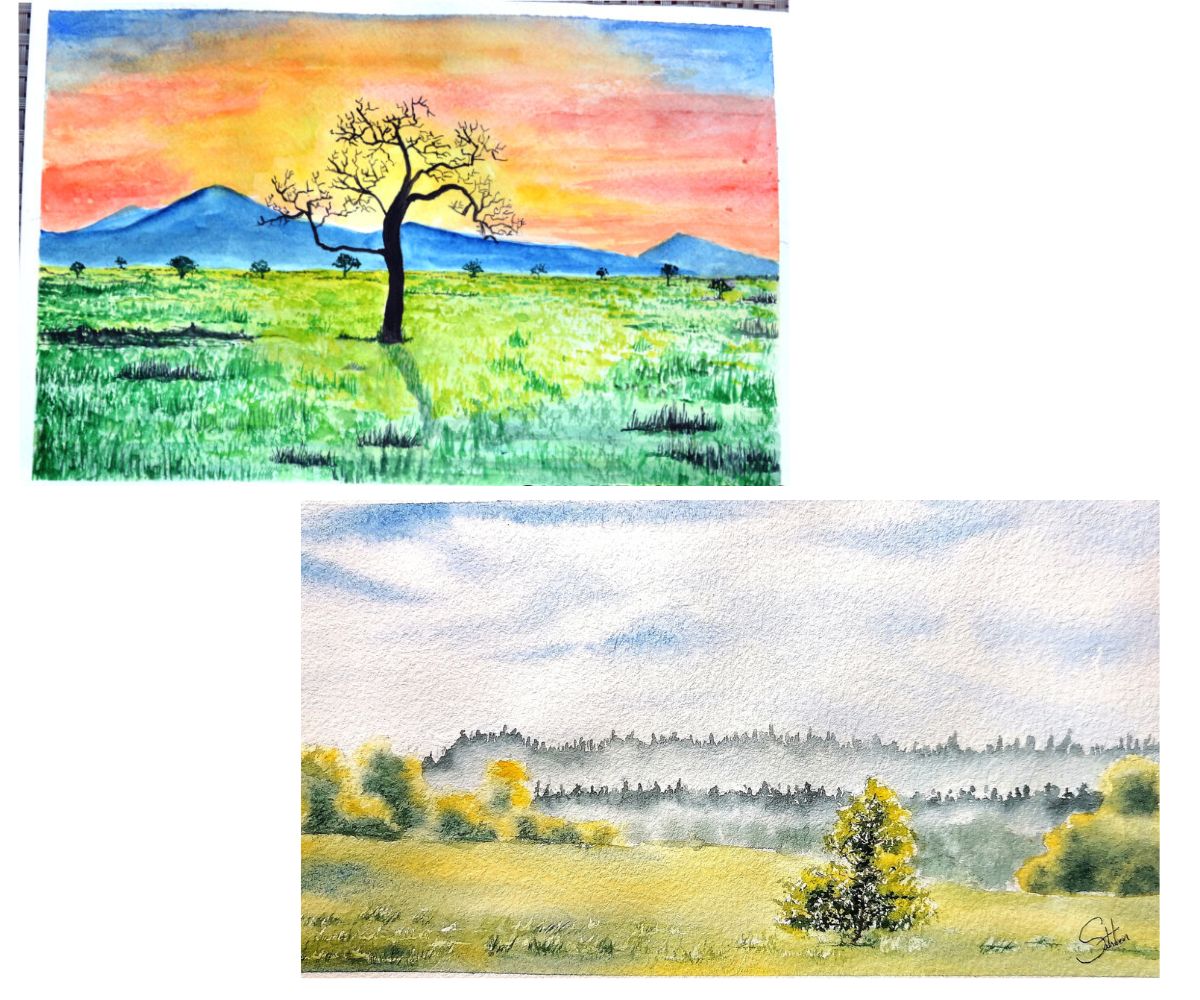
In the paintings above, you can see how I used to paint grass and trees; there’s a certain stiffness in the painting. After reflecting, I tried a looser approach to painting trees and grass.
The painting on the bottom is one of my recent pieces; you can see how much of a difference there is in the way I painted the trees and grass.
5 Signs You Are Developing Your Painting Style
Some artists develop their painting style without ever thinking about it! A few signs you may be developing your painting style are:
- You no longer copy or strictly follow along with other artists’ tutorials.
- Being more intentional when planning. You spend more time sketching and planning your paintings. You take the time to think about what to add, change, and remove.
- You have a sense of discernment when studying accomplished artists, understanding what they did very well and what you would change.
- Your paintings look more coherent and consistent than before.
- Exploration is still part of your process, but you’ve narrowed your focus a little more.
- You may notice similar mood, subject, and theme in your work.
Is it okay to copy other artists?
If done right, copying is an excellent tool to learn and develop your skills. However, you have to copy while still maintaining a mind of your own.
It’s better to copy an artist’s work as inspiration, not as the end goal.
Copy to learn
If you have an artist or two whose work you love and that you are inspired by, then it’s okay to copy their paintings.
However, don’t just copy to make pieces that look exactly like theirs.
If you want to develop your own style, then take it a step further by asking yourself what you liked about their painting in particular and what you would change.
This will develop your natural instincts of discernment, creating a unique painting style.
Credit where credit is due
Never plagiarize and take credit for another artist’s work. If you copy someone’s work and post it, then always credit the original artist.
This one is obvious, but I’ll still mention that you should never resell their hard work without their written permission. Artists spend years mastering their craft, and it’s unfair and frustrating to see your hard work being stolen.
When should you focus on developing a painting style?
If you are an absolute beginner, then worrying about your painting style should be the least of your concerns.
As an absolute beginner, your focus should be building foundational skills. Water control, basic shapes, value, color, drawing perspective, and composition. There’s no need to overwhelm yourself further.
Once you’ve learnt the foundational skills, you go from absolute beginner to beginner stage. This is the best time to allow yourself to explore.
Try experimenting with techniques, painting different subjects, study other artists’ work.
The intermediate level is the perfect stage to start thinking more about building a recognizable painting style.
You now know the basics, and have practiced enough to focus on design concepts. You focus less on following tutorials and more on composition, color schemes, and technique. Usually by this stage you’ve found a general subject you gravitate towards.
How to Find Your Painting Style (7 tips)
If I were to summarize my advice on how to find your painting style into a few tips, it would be these 7 tips:
- As a beginner, you shouldn’t worry about your painting style. Learning the fundamentals is already enough on your plate.
- Study the artists you find inspiring and use their work as information to help you, not the end goal.
- If you have found your painting style, it doesn’t mean it’s going to stay the same forever. Artists also evolve.
- Finding your style has less to do with finding something that’s missing and more to do with learning what you gravitate towards.
- Exploring without pausing to reflect will leave you lost and all over the place.
- Study and reflect on your own paintings more than you study the paintings of inspiring artists.
- Don’t be afraid to use a combination of materials, techniques, and subjects that may seem “unconventional”.


I hope you found this post helpful. If you did, feel free to subscribe to my email list so you can get notified when I release new content.
You can also sign up for my email list and receive three watercolor beginner packages for free.